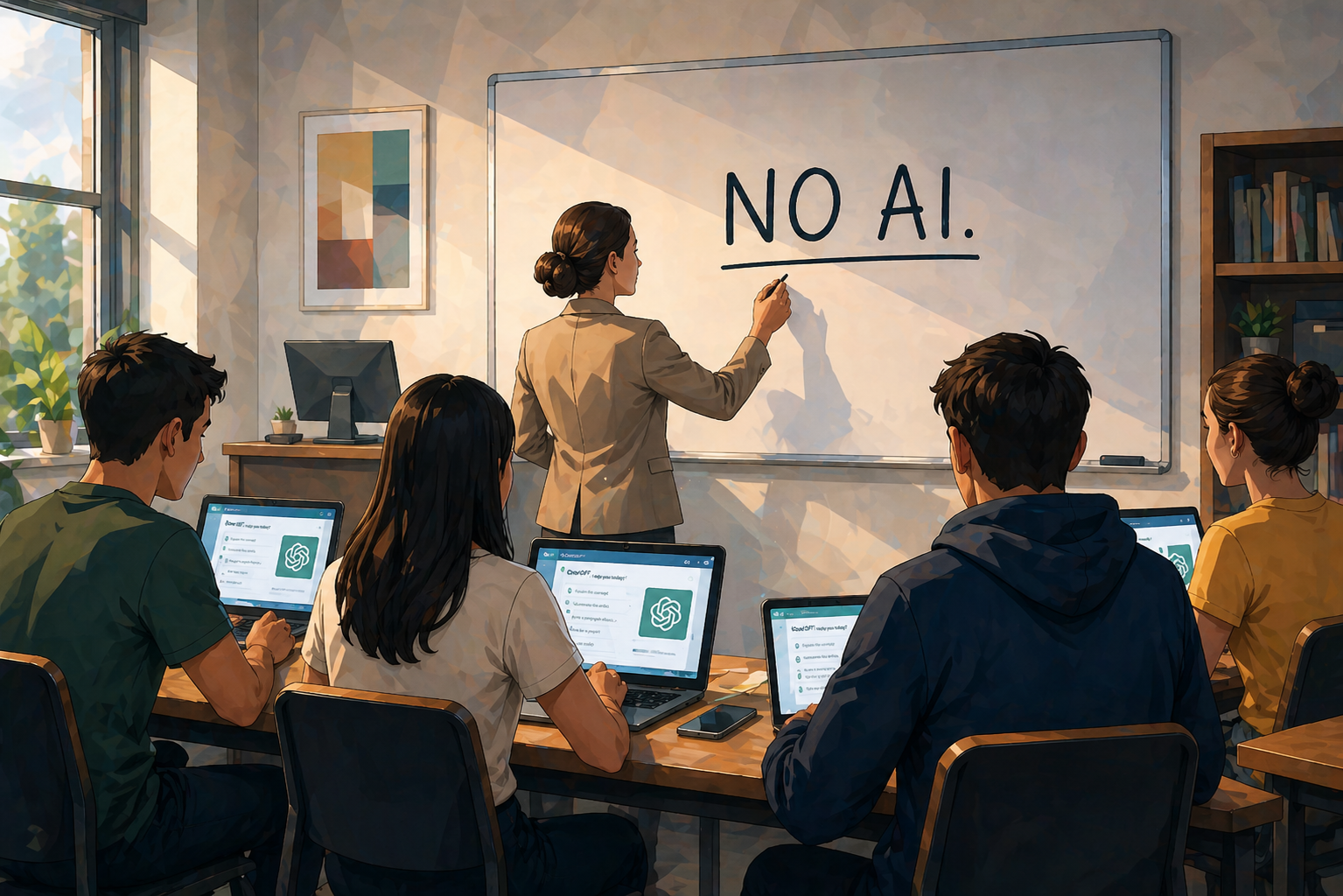
The Problem
Professors are walking into classrooms in 2026 armed with policies written for a problem they don't fully understand, directed at students who understand it better than they do. That's an uncomfortable thing to say. It's also true.
Here's what the average student knows on day one. They know which AI tools exist. They know which ones are good at which tasks. They know how to prompt them, how to clean up the output, how to make it sound like their own voice. They learned this not because they were trying to cheat but because it's everywhere and it's useful and they're not going to pretend otherwise.
"The policy doesn't fail because students are bad. It fails because it asks them to ignore a tool that their future employer is going to expect them to use fluently."
Meanwhile the professor is distributing a policy that treats AI like contraband. No use permitted. Academic integrity violation. Submit your own work. The student reads it the same way they read the terms and conditions on an app — technically, yes, but not really.
You're not protecting them from something dangerous. You're asking them to practice being less capable than they need to be. And somewhere in that classroom, a student is thinking: they don't actually know how this works. They're just scared of it.
That's a bad place to start a semester.
Why the Standard Approach Makes It Worse
The instinct to ban AI and move on is understandable. Nobody wants to redesign a course they've taught for eight years. Nobody has time for that. So the policy goes in the syllabus, a vague warning gets delivered on day one, and the subject gets dropped.
Banning AI without a conversation doesn't eliminate AI use. It just makes it secret. It does turn into contraband. Now instead of students engaging openly with the tool and developing real judgment about when it helps and when it doesn't, they're hiding it. You're banning a healthy relationship. You've taken something that could be a teaching moment and turned it into a compliance game.
"Treating AI as taboo hands students something they should never have: the feeling that they know more about this than you do. Once they believe that, you've lost the room."
The students who were going to cheat are still cheating. The students who weren't are now anxious that their integrity will cost them on the job hunt. Great outcome. Really cleared things up.
Treating AI as taboo also hands students something they should never have: the feeling that they know more about this than you do. Once they believe that, you've lost the room. Not on AI specifically. On everything. Authority in a classroom isn't just about credentials. It's about whether the person at the front of the room is engaging seriously with the world as it actually is. Silence on AI tells students you're not.
The Real Insight
Here's what actually works, and of course it's the thing almost nobody is doing: have the honest conversation on day one and make it interesting.
Not a warning. Not a policy reading. An actual conversation. Ask them what they use. Ask them what they think it's good at. Ask them where they think it fails. Most students have never been asked this by a professor and the room will wake up immediately because suddenly the class feels like it's about their actual lives.
Then flip it. Tell them you're going to make them use AI on certain assignments. Tell them the goal isn't to produce output — it's to understand what they're producing well enough to defend it, improve it, argue with it. Tell them that where they're going after graduation, no one is going to hand them a policy about what tools they can use. They're going to be expected to produce good work and explain their thinking. That's the skill.
What Day One Actually Needs to Look Like
Design the course around what a new graduate actually does in their first job using AI, and build the conversation backward from there. What decisions will they need to make? What judgment will they need to exercise? What will they need to explain to a manager or a client without a tool doing it for them?
That's the curriculum question. The day one conversation follows naturally once you've answered it.
The New Approach
- AI is allowed, encouraged in some cases, but irrelevant to your final grade if you can't explain what you submitted
- Oral defense of work becomes a normal part of how the class operates
- Make AI the thing you're all figuring out together, with you leading the conversation
Tell students explicitly: AI is allowed, encouraged in some cases, but it's completely irrelevant to your final grade if you can't explain what you submitted. Make the oral defense of work a normal part of how the class operates, not a punishment reserved for suspected cheaters.
Don't make AI the enemy of your classroom. Make it the thing you're all figuring out together, with you leading the conversation instead of avoiding it. That's huge.
The students already know AI is in the room. You don't have to call it out in that way. The only question is whether you're going to acknowledge it or pretend otherwise. One of those choices builds trust. The other one just makes you look like you haven't been paying attention.
Remember what we said at the start? The student who already knows more about AI than their professor does? That student responds to a professor who meets them where they are. Completely differently than they respond to a syllabus warning.